Outcome
SiftSight has been in active development since August 2025. The candidate, recruiter and admin apps run on the shared API, and the public demo at demo.siftsight.com shows the candidate and recruiter sides of the product.
A recruitment platform that matches verified candidates with recruiters. Candidates prove who they are and what they can do, and recruiters hire through pipelines, messaging and interview scheduling in one place.
0→1
SiftSight connects verified candidates with recruiters through AI matching. It is built around trust: a recruiter can only rely on a match if the candidate’s identity and skills can be checked, so verification sits at the start of every candidate’s journey.
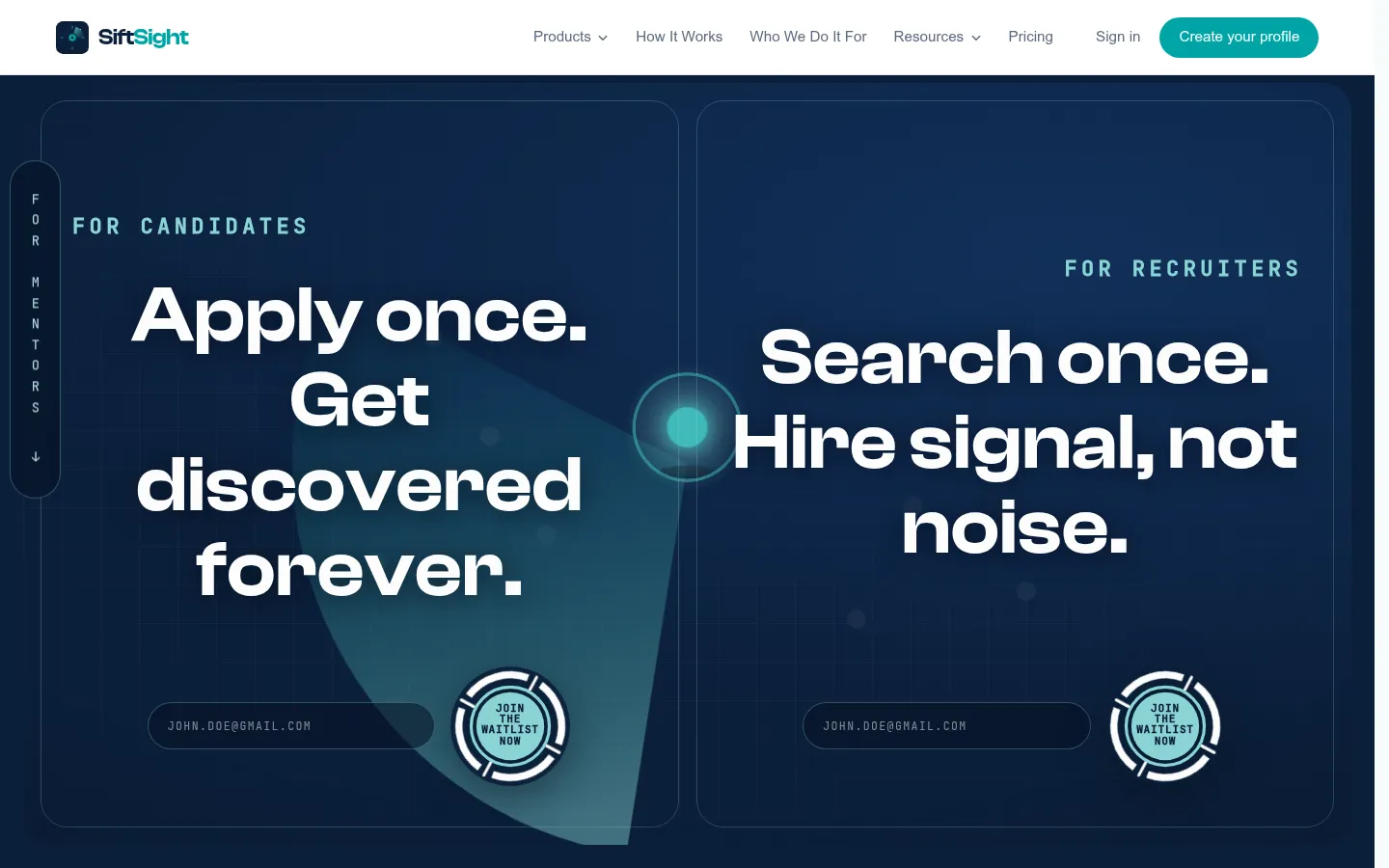
Candidates build a profile step by step, verify through LinkedIn and an ID check, take scored assessments and set their availability and location preferences. Recruiters search and shortlist verified candidates, move them through Kanban pipelines, message them in real time and book interviews. Admins review verifications, manage users and follow subscriptions.
I set up the architecture and the monorepo, then built the core of the product myself.
Matching. Candidates and roles are matched with embeddings and similarity ranking. Candidates get job recommendations, and recruiters get a ranked list they can narrow with search and filters.
Pipelines and scheduling. Recruiters track candidates on Kanban pipelines and shortlists. Messaging and notifications run in real time over WebSockets, and interviews are booked straight into Google Calendar.
Verification and assessments. LinkedIn and ID verification, scored assessments, the admin console where verifications are reviewed and approved, and recruiter subscriptions on Stripe.
Three Next.js 15 apps, one each for candidates, recruiters and admins, live in one monorepo with a shared NestJS API. The API holds the business rules and the matching service, and each app calls it through the same typed client. Sign-in uses JWT with Google and LinkedIn login and two-factor authentication.
PostgreSQL stores profiles, pipelines and reference data such as industries, skills and job functions, and PostGIS answers location and commute searches. WebSockets carry messaging, Google Calendar holds interviews and Stripe runs subscriptions. Each recruiting company is its own tenant, so a team sees only its own pipelines and shortlists.
4 decisions
Candidates, recruiters and admins each get their own Next.js 15 app, and all three share one NestJS API. Keeping them in a single monorepo puts the types, the API client and the business rules in one place. A change to a shared rule lands in all three apps in the same pull request.
Trust was the hardest constraint. A match is only useful if the recruiter can rely on who the candidate is and what they can do. So candidates verify through LinkedIn and an ID check and take scored assessments, admins approve verifications in the console, and recruiters browse a talent hub of verified people.
Candidates and roles are turned into embeddings and ranked by similarity. That matches on meaning, so a candidate who describes a skill in different words from the job post still comes up. Recruiters can then narrow the ranked list with ordinary search and filters.
Candidates set where they want to work, and recruiters search by place and commute. PostgreSQL with PostGIS answers those distance questions in the database, next to the rest of the profile data. Locations are stored as a hierarchy, so a search can work at different levels of place.
Feature level
From the project record
Result
SiftSight has been in active development since August 2025. The candidate, recruiter and admin apps run on the shared API, and the public demo at demo.siftsight.com shows the candidate and recruiter sides of the product.
Looking back
I would settle the data model earlier. Three apps read and write the same profiles, verifications and pipeline stages, so a late change to any of them has to be carried through all three. Fixing those core records before building the apps would have kept that work small. The same lesson came up on Deeplawn and Terravive.