Outcome
TripTalk is live at triptalk.app. Travellers ask Drew's assistant questions by voice or chat, generate itineraries, and get answers drawn from his content and the country knowledge graph.
Drew Binsky's AI travel companion. Travellers talk or chat with an assistant grounded in his YouTube videos, Instagram posts and a knowledge graph of countries.
0→1
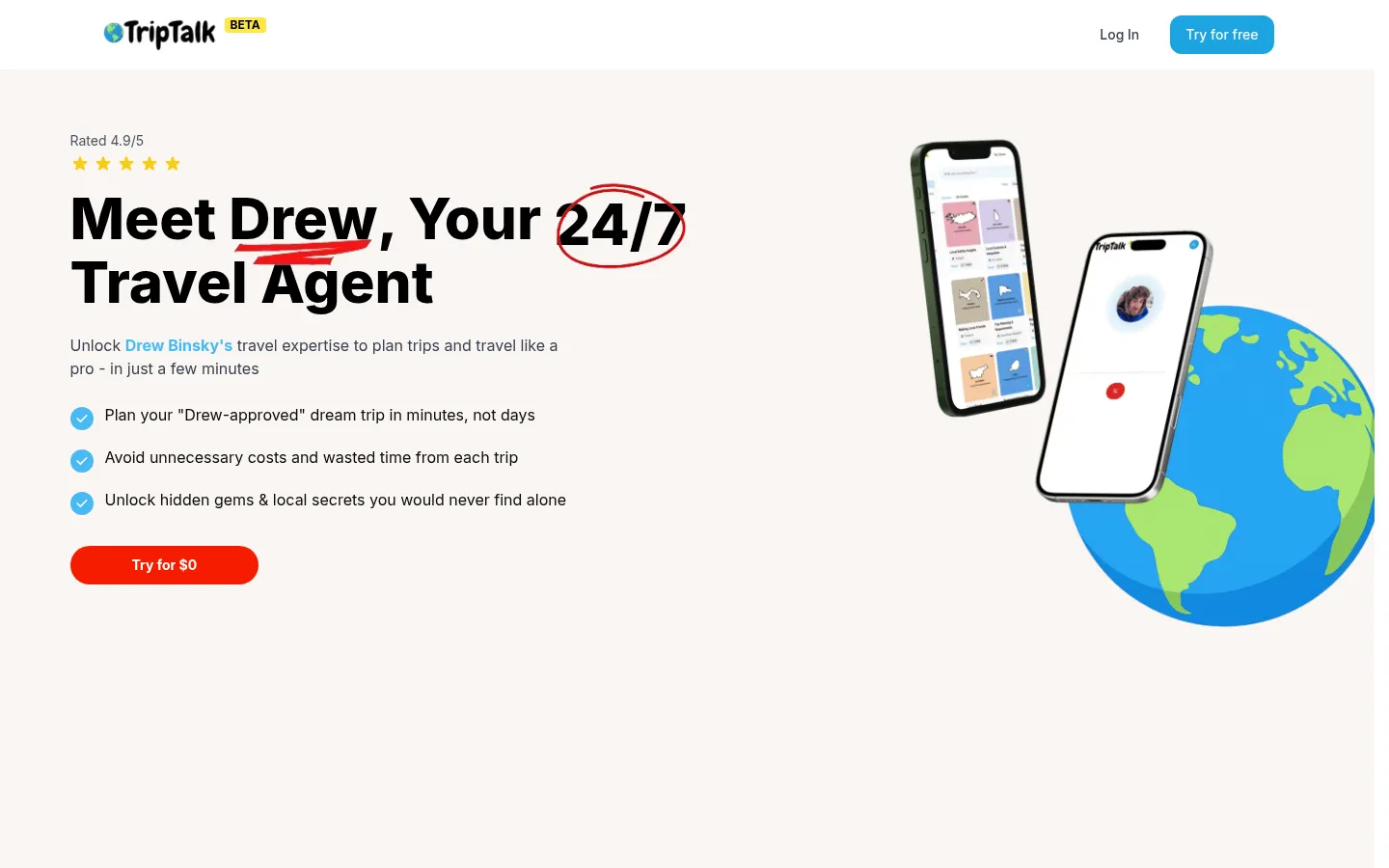
TripTalk is an AI travel companion for the travel creator Drew Binsky. Travellers ask questions by voice or chat and generate itineraries, and the answers draw on his YouTube videos, Instagram posts, blogs and a knowledge graph of countries.
The hardest constraint was answer quality when most of the source is video. An answer has to come from what Drew actually said, and spoken content is looser than written text.
The RAG pipeline. Ingestion of his YouTube and Instagram content into a vector index, and retrieval from it for each question.
Voice and chat. The assistant experience travellers use, by voice or by typing.
Knowledge graph and payments. The country knowledge graph that answers sit on alongside the creator content, and the Stripe work.
The web app is Next.js with voice and chat. A question goes to a LangChain retrieval layer, which searches Drew’s content in Pinecone and looks up country facts in the knowledge graph, then OpenAI writes the answer from both. RabbitMQ handles queued work, Supabase holds the app’s data and Stripe takes payments.
3 decisions
Country facts live in a knowledge graph, and Drew Binsky's content lives in a Pinecone vector index. Facts about a country need to be exact, while his videos and posts are searched by meaning. The two are combined when an answer is put together.
The assistant answers from what Drew has published. His YouTube videos, Instagram posts and blogs are ingested into the index, and each answer is built from the passages retrieved for the question.
Voice and chat use the same LangChain retrieval layer, so a traveller gets the same grounded answer whether they speak or type.
Feature level
From the project record
Result
TripTalk is live at triptalk.app. Travellers ask Drew's assistant questions by voice or chat, generate itineraries, and get answers drawn from his content and the country knowledge graph.
Looking back
I would set up answer-quality evaluation earlier. Answer quality was the hardest constraint, and without a fixed set of questions with known good answers it is hard to tell whether a change to retrieval or prompts made answers better or worse. Building that set first would have made every change measurable.