Saraan Asim
Vectadiff is my own product, and I am building it alone. It is live, in early access, for commercial subcontractors and mid-market general contractors. I built it because estimators lose days to manual takeoff.
The problem
A subcontractor bidding on a commercial job gets a set of drawings and a book of specifications, and has to turn them into quantities and a price. Today that usually means three to five tools that don’t talk to each other, with numbers copied from one to the next. Then the architect issues an addendum shortly before the bid is due, and the estimator re-checks sheet after sheet by hand.
What it does
Drawings and specs go in, and a proposal comes out. In between:
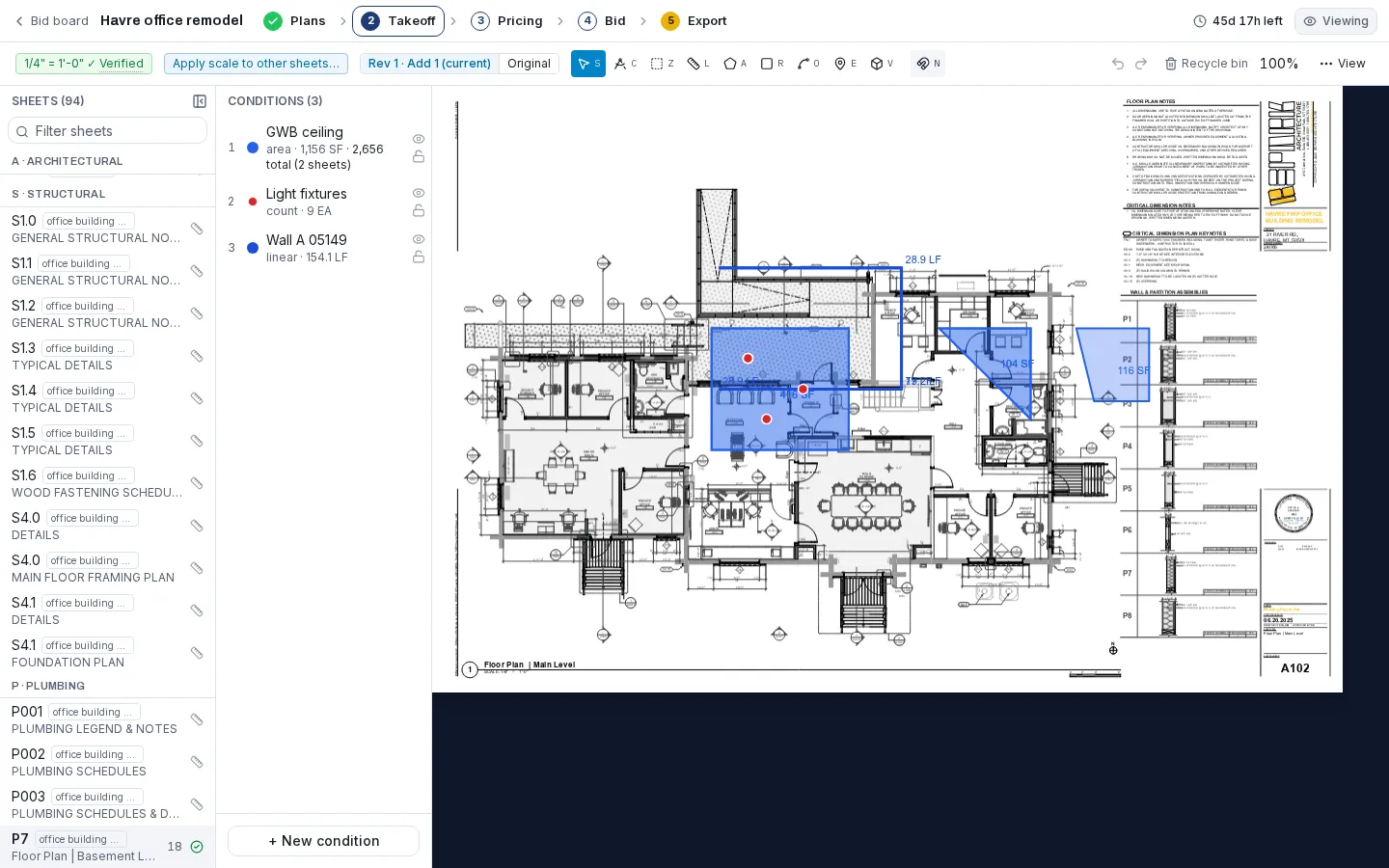
- Vector takeoff. The estimator calibrates a sheet with two points and measures lengths, areas, volumes and counts directly on the drawing. One shape expands into its full material list through assemblies, so a wall becomes studs, track, drywall, tape and compound.
- Spec parsing. Claude reads the specifications and pulls out the clauses that cost money, with a link back to the page and section, and drafts the questions to send back to the architect.
- Addenda diffing. Each addendum is overlaid on the sheet it replaces as a pixel diff, so the changes are visible at a glance.
- Pricing to proposal. Unit costs, labor, waste, tax and alternates roll up into a bid form PDF and a schedule of values export.
How it is built
Next.js on Vercel for the app and the server routes. PDF.js renders the drawings in the browser and Konva draws the takeoff on top, so heavy PDF work stays on the user’s machine. The drawings themselves go straight from the browser to Cloudflare R2.
Supabase holds everything else: Postgres, auth and storage in one place. That’s what let me ship alone without running my own infrastructure. Postgres row-level security keeps each company’s data walled off from every other company’s at the database level, so I don’t rely on every query remembering to filter.
I test the main flows end to end with Playwright.
What I would do differently
Start with a narrower first wedge. Takeoff, spec parsing, addenda and pricing are four hard problems, and I took on all four for the first version. If I started again, I’d begin with takeoff and pricing only: quantities from the drawings through to a priced bid. Spec parsing and addenda would come after that part was excellent.